Subscribe via E-mail

Your email:

Follow Me

Naples Shutter Blog

Current Articles | RSS Feed RSS Feed

Wood vs. Poly: Which Plantation Shutter Material Suits Your Needs?


So, you have decided on plantation shutters to decorate your windows.  Your next decision is whether to choose shutters made from natural wood or man-made poly materials.  Your friends are giving you conflicting information – some say wood, some say poly, and quite frankly, you don’t know which way to turn.  Here is an easy point-by-point breakdown of the pros and cons of each, so that you can choose the plantation shutter material that’s right for you and your home.

Plantation Shutter MaterialWood Shutters

Pros

  • Natural beauty.  Let’s face it, nothing compares to the natural wood grain, rich color variations, and sheen of real wood.  At Naples Shutter, we use poplar and basswood, because of their outstanding durability and beauty.  Check out the stunning examples in our web gallery.
  • Unlimited color choices.  Wood shutters can be painted any color under the sun.  Most clients choose to paint their shutters the interior trim color of their house.  This helps the shutters fit in seamlessly with the décor.
  • Staining available.  If you prefer the look of stained shutters, then wood is the right choice for you.  We can custom match the stain of your trim, cabinets, or furniture so your shutters blend in perfectly.
  • Stronger & Lighter in Weight.  Wood is stronger than poly, yet lighter in weight.  This allows for greater durability, but it also means that you can have a larger panel size with wood shutters.  Why? Because the weight of the poly can cause the shutters to “sag” on the hinges if they are made too large.  Why does panel size matter?  Well, it determines if you can cover your window using only two shutter panels or if you need to use four panels.  Most people prefer the cleaner look of two when possible.
  • Limited Lifetime Warranty.  At Naples Shutter, our wood plantation shutters come with a limited lifetime warranty, guaranteeing the quality, workmanship, and installation for the life of the shutter.  Our service team is always available to make any adjustments or repairs you may need.

Cons

  • More Expensive.  Wood shutters are more expensive than poly shutters, but the difference is not dramatic.  We recommend comparing both products.
  • May need repainting.  Like any painted surface in your home, the painted finish on your shutters will age over time.  With normal conditions, you probably won't need to have the shutters repainted for about 15 years.

Poly Shutters

Pros

  • Durable, long-lasting finish.  Poly material is very tough and durable, and will hold its color throughout the lifetime of the product.
  • Less Expensive.  Poly is slightly less expensive than wood, so if wood plantation shutters are out of your budget, definitely consider poly.
  • Moisture resistant.  Some windows are in areas that are prone to moisture, such as garages and lanais.  Poly is a good choice for these areas, because it is not prone to warping when exposed to moisture and humidity.

Cons

  • Weight.  The poly material weighs more than wood, so a shutter made of poly is much heavier than a wood panel.  Why does this matter?  Well, more weight puts more pressure on the frames and hinges holding the shutter in place.  If the panels are made too large, they can sag and fall out of square.  That’s why Naples Shutter limits the size of poly panels so they will perform correctly.
  • Limited color choices.  Poly shutters are available in either white or off-white.  While these colors are perfectly acceptable in the majority of situations, clients wanting to match their trim color exactly or wanting a unique paint or stain color should consider wood.
  • Limited panel sizes.  As we mentioned above, the maximum size of a poly shutter is smaller than that of a wood shutter.  This means that you may need more shutter panels to cover an opening with poly.  Some clients are fine with this and some prefer the cleaner look of fewer panels across their window opening.

Don’t Forget About PVC!

Now let's not forget a very important “cousin” to poly panels, and that is the PVC shutter.  As you probably know, PVC (polyvinyl chloride) is a plastic widely used in construction because of its durability and light weight.  PVC is the perfect material for shutters that will come in direct contact with water, such as a shower.  PVC shutters will have a distinct shiny, plastic look, and would not be most people’s first choice for their living areas, but they are a great solution for wet applications.

The Bottom Line

So with all of that said, which plantation shutter material is right for you?  Well, at Naples Shutter, we have coached over 40,000 satisfied clients over the last 30 years through this decision and here’s what we have learned from our experience.  Wood plantation shutters are the preferred material for the vast majority of clients and give years and years of beauty and flawless operation.  However, if price is a limiting factor, poly shutters are a close second.  Poly is durable and attractive, and if you are willing to accept limited color choices and panel sizes, it may be right for you.  Either way, your Naples Shutter product expert will evaluate your home and your situation to make the recommendation that’s right for you.

Check out our Wood vs. Poly Demonstration here.


HELP! MY PLANTATION SHUTTERS WON’T STAY OPEN


If you have plantation shutters, you already know about their superior beauty and functionality.  But, you may experience a time when the shutter louvers don’t stay in the desired position.  You open them, they fall closed.  Or, the opposite may be true when the louvers feel very difficult to move and you’re afraid you may break them by forcing them too hard.  Well don’t worry; this is a normal occurrence that is quickly solved using just a screwdriver.

Plantation ShuttersWhat Happens To Your Plantation Shutters

Over the course of time, the wood in the plantation shutters can slightly expand and contract depending on temperature, humidity and other factors.  This is normal.  The change affects the way the moving parts of the shutter fit together.  When we change the tightness of the louvers, this is called adjusting the “louver tension.” Here’s how to do it:

Adjusting Louver Tension

1)      Swing the shutter panel all the way open on its hinges.  Locate the hole on each side of the shutter panel.  Inside the hole is a screw called the “tension screw.”

2)      Using a Philips head screwdriver, turn the screw ¼ turn to the right to tighten the louvers or ¼ turn to the left to loosen them.  Be sure to adjust the screws on both sides of the panels.  Very tall shutters may have more than one tension screw on each side.

It's as simple as that! Your shutters should be back in top-notch condition.  If you still have difficulty, feel free to call Naples Shutter at (239) 566-8161.  We will gladly schedule a service technician to come to your home for further assistance.  

Did You Know...

P.S.:  Did you know that Naples Shutter repairs, repaints, and reconditions all types of aging plantation shutters, even if they were not purchased from us?  If your shutters are in need of some extra attention, just click below or call us at (239) 566-8161 to discuss your project.  We can give new life to your old shutters.


Window Treatments, Rules To Live By: Lesson 3


Welcome to the final installment on window treatments and the rules to live by when choosing what suits your needs. Today, we will be talking about how to keep your window treatments consistent throughout your whole house, while also keeping safety in mind.

Window treatments blindsWindow Treatment Consistency

When you dwell in your house every day, it’s important to create a cohesive feel as you move from room to room.  Does this mean that every room has to be a cookie cutter image of the next?  No.  Does this mean that you can’t have whimsical areas in your home that are unlike any others?  Also no.  Does it mean that you should find an element that remains consistent throughout the home to create harmony?  Yes! 

This could mean plantation shutters throughout, or it could mean shutters on the front façade and woven wood shades elsewhere.  This could mean adding drapery panels to each of the living areas, using different fabrics that compliment the room’s décor, but keeping the drapery style the same.  The mission here is not to be boring, but to create a nice flow throughout the house.  This will create a sense of peace and belonging.

Safety of Children and Pets

Window cords can pose a potential strangulation hazard to young children. According to the U.S. Consumer Product Safety Commission, corded window coverings are among the top five hidden hazards in American homes. Check your window coverings for exposed or dangling cords and retrofit or replace them with today’s safer products. Safety experts recommend using only cordless window coverings in homes with young children. To obtain a free retrofit kit for older corded window blinds, shades and draperies, as well as Roman shades and roll-up blinds, visit http://www.windowcoverings.org/.

Window Treatment Layering

So even though you decide that plantation shutters are the right look for you, go ahead and add luxurious drapery panels to the same window.  Or if wood blinds are the right choice for your kitchen, top them off with a fun fabric valance.  For your large sliding glass doors, a cornice made of a rich fabric or even woven wood material is a great way to give your doors a finished look.  Go a little crazy!

The bottom line is that when chosen correctly, your window treatments will serve you well for many years to come.  Take the time to identify your needs and you will have a beautiful finish to your home.


Window Treatments, Rules To Live By: Lesson 2


If you caught last week's lesson on window treatments, you learned to not be afraid to experiment with the different types of window coverings, including shades, drapes, and plantation shutters. You also learned how to determine what you want your windows to be able to do for you. This week's lesson teaches us to look for the ways in which we plan on using our window treatments.

Window treatmentThe Usage of Your Window Treatments

When choosing window treatments, decide whether they will remain stationary most of the time or if they need to be opened and closed each day.  For example, in the family room, you may want an open view during the daytime and privacy at night.  Be sure to choose a window treatment that you can easily operate by hand, or choose a motorized option. 

I’ll never forget a home we rented temporarily that had a large bank of windows in the family room covered with seven heavy roman shades.  Every morning, I had to heft up each shade by hand and secure the cord.  Then, every evening I had to release the cords and lower all seven shades.  It got to be quite a hassle!  Plantation shutters would have been much easier since they can be tilted open or closed with just a touch. 

MOTORIZATION

Great strides have been made in window treatment motorization lately. Most blinds and shades can be operated with a simple battery pack in the headrail and a remote control.  If you have a very large shade, its weight may require the use of an electrical outlet, but it can still be easily operated with a convenient remote.  Speak to your window treatment dealer about exciting new options.

Proper Direction To Open And Close Your Window Treatments

Many people choose window treatments based on how they look standing still.  However, window treatments are constantly in motion and this motion should be considered when making your decision. 

HORIZONTAL VS. VERTICAL

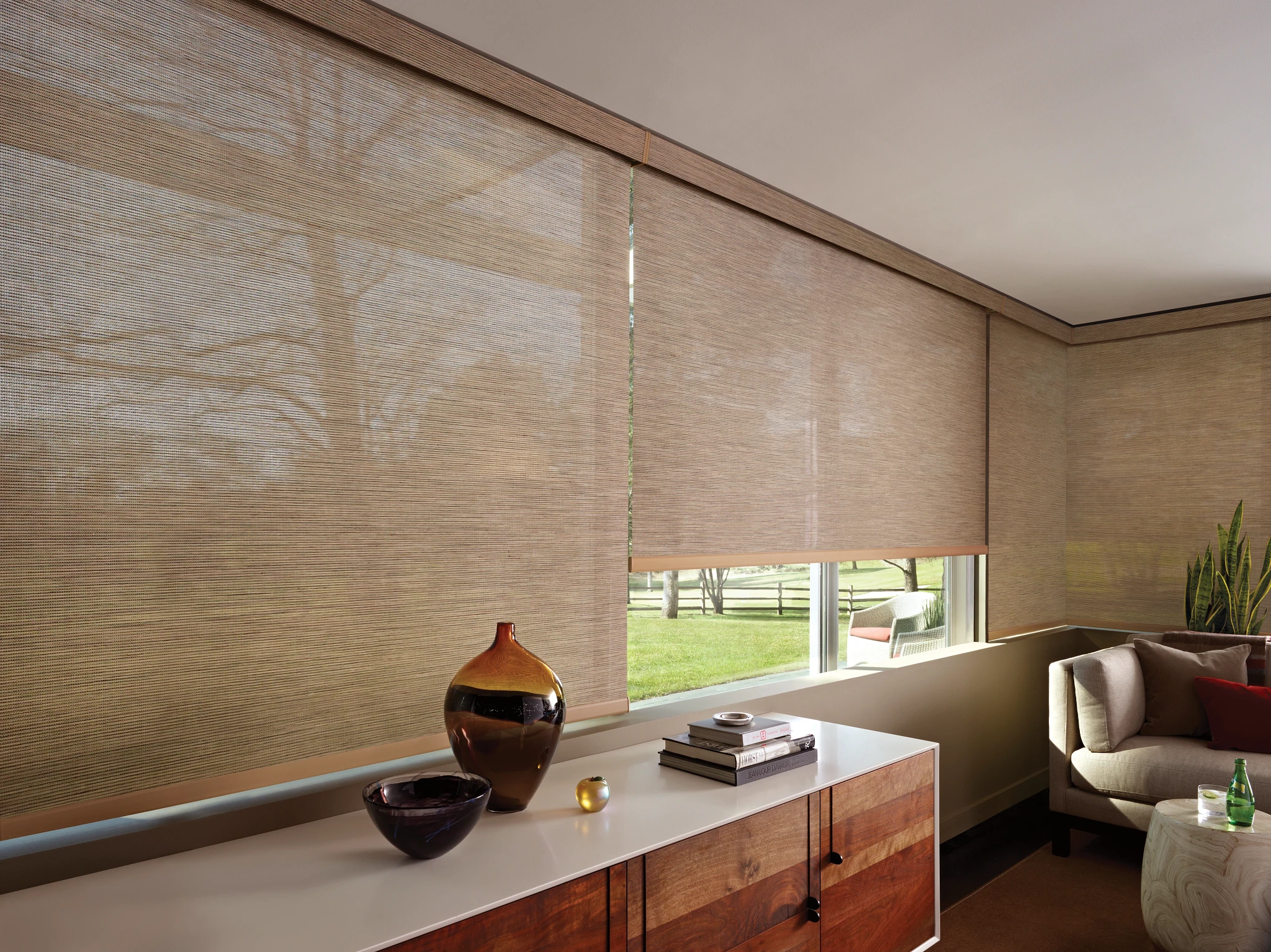
Let’s consider a sliding glass door.  You may love the look of woven wood shades and select the perfect pattern and color.  You probably assumed it would need to be mounted from the top and lower down over the glass.  What happens when you need to open the door just a crack and step outside?  You have to lift the entire shade, which can be quite cumbersome. 


Did you know that woven wood shades can also be mounted vertically?  That means that they can stack side to side, allowing you to open one side just a crack to allow access to the sliding glass door.  Gone are the days of vertical blinds being the only choice for sliding glass doors.  Check out the Hunter Douglas Vertiglide for a honeycomb option (the company just introduced a new upscale line of color choices), Skyline gliding panels, The B&W Averte, and of course drapery panels and sheers.

OBSTACLES

Always evaluate your window or door opening for obstacles that may be in the way of opening and closing your window treatments.  Plantation shutters generally swing open on hinges, so a cabinet, a bookshelf or a kitchen faucet might be in the way.  Certain shutters can be installed as a “pop-in” panel with magnets for easy removal around obstacles.  Also be on the look out for crown moulding or sprinkler heads near ceiling height.  These might affect the operation of the blinds, shades or shutters, as well as the ability to install them with proper clearance.

Join us for our next lesson later this week, where we will be talking about how to keep your window treatments consistent and safe throughout your entire home.


Window Treatments, Rules To Live By: Lesson 1


Choosing window treatments for your home can seem like a daunting task, but if you know what rules to keep in mind, it could prove to be an easy, enjoyable experience.  Once you have established what you need your window treatments to accomplish, you can proceed with confidence along with your window treatment provider.  Soon you will be enjoying the view both inside and outside of your room. This week's lesson is about learning what you want from your windows.

Window treatmentsYour Window Treatment's Purpose

    The age-old saying, “Form follows function,” also applies when choosing your window treatments.  Believe it or not, what your window covering does is more important than how it looks.  Do you need to block the neighbor’s view into your bedroom?  Control the sun’s glare in the afternoon?  Add color or texture to an otherwise bland room?  If any of these needs are unfulfilled, you will be unhappy with your choice, no matter how attractive it is in photographs.

    PRIVACY

    For privacy, you have plentiful options these days.  If you like the bold architecture of plantation shutters, you can have them installed with a midrail, which allows you to open the top louvers independently of the bottom ones.  That way, you can leave the top section open for light, while the bottom section remains closed for privacy.  Prefer the rich texture of woven wood shades?  There is a world of color and style to choose from in this popular window treatment. 

    LIGHT CONTROL

    If you want to diffuse the natural light, but not block it out completely, consider a honeycomb shade like Hunter Douglas’ Duette, a luxury shade such as the Hunter Douglas Silhouette or Luminette, or plantation shutters.  If you want to block more light, some shades do offer a blackout lining, but your best bet is to “layer” the window with multiple treatments. 

    For example, start with a dark walnut stained woven wood shade and add a pair of inverted pleat drapery panels in a natural earth-tone print.  Add a blackout lining to the draperies, and hang them from a bamboo rod with bamboo rings.  For a crisp, clean look, install white plantation shutters and top with a vertical striped drapery.  Use blackout lining on the drapes, and add a grommet top with a stainless steel rod for a modern look. 

    (Hint: To make the room appear larger, have drapery panels made to extend the entire height of the wall—from about ½” off the floor to within a few inches of the ceiling.)  Remember that no window treatment can block 100% of sunlight from entering a room, but it can be vastly reduced.

    DECORATION

    While window treatments do serve a purpose, they are also a major factor in the room’s décor.  For a subtle look that adds texture and dimension, choose a fabric one shade lighter or darker than your wall color.  For a real “pop” to your room, choose a bold print or a bold color for the primary fabric.  When possible, repeat the fabric elsewhere in the room with pillows, bedding, or even an upholstered headboard.  Many designers follow the “Rule of Three” when choosing fabrics:  begin with a large print, and then choose a coordinating small print and a stripe or plaid.  I find adding another solid color with texture works well, but be careful not to add too many fabrics in one room.  It can sometimes feel like clutter to the eyes.

    No matter which window treatments you choose, don’t be afraid to layer them and have some fun.  There is no better way to add personality, color and dimension to your room than by decorating your windows.  They occupy a large amount of real estate in the space and provide ample opportunity to express your design tastes. Tune in next week to learn more about choosing the right window treatments for your lifestyle.


    Hurricane Fabric 101: What the Heck is it, Anyway?


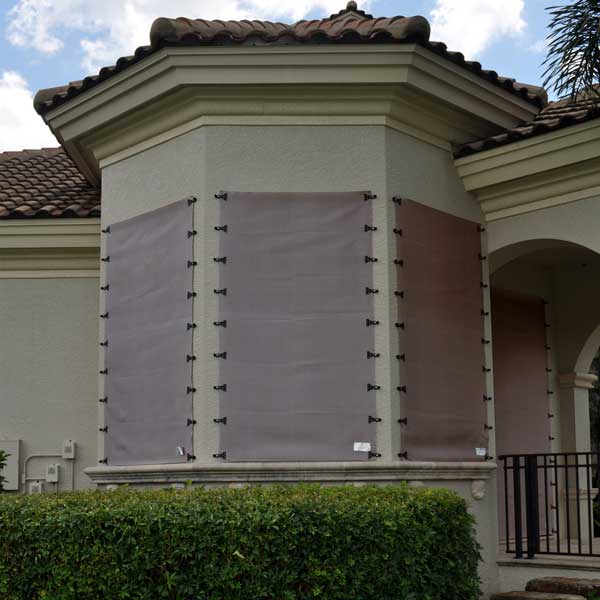
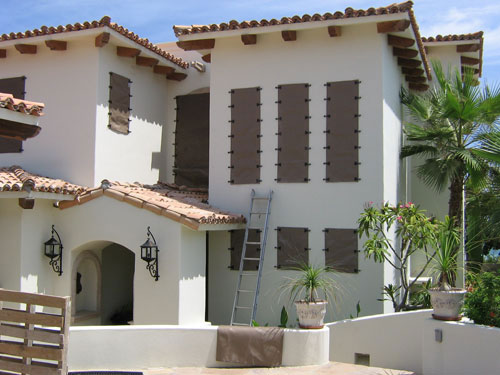
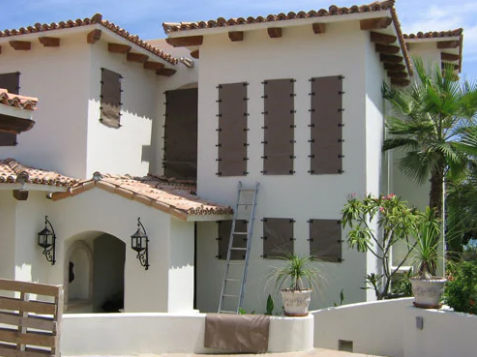
    Here at Naples Shutter, we get calls every day from people who say, "Tell me about this hurricane fabric."  They may have heard about it from a friend, a neighbor, seen it on the news or seen one of our ads.  But they all have one thing in common:  they are incredibly skeptical that any kind of fabric could defend against hurricanes.  Well, today we will answer the most common questions people have about hurricane fabric and hopefully solve a few mysteries.AstroGuard Hurricane Fabric

    WHAT is AstroGuard Hurricane Fabric?

    AstroGuard Hurricane Fabric is a woven nylon that is coated with a UV resistant resin. Other companies use polypropylene, which will deteriorate in sunlight, but with its unique UV coating, AstroGuard Hurricane Fabric can be deployed on your home, even while you're not there. It is also attached with a clip system, which makes deploying it even easier than using traditional grommets. Tested up to 200 mph winds, AstroGuard has out-performed all other forms of hurricane protection.

     WHEN Should I Use Hurricane Fabric?

    AstroGuard Hurricane Fabric can be used to protect your home and family from all tropical storms and hurricanes. It protects all glazed openings from flying debris and prevents pressure from building in the home. Taking only a fraction of the time that it takes to deploy traditional metal storm shutters, AstroGuard is an easy way to protect your home when a storm is quickly approaching.

    WHERE Is AstroGuard Hurricane Fabric Approved For Use?

    AstroGuard Hurricane Fabric is approved by the Florida Building Code #15208 and the Miami-Dade County, NOA #10-0607.02. It is also used world-wide with dealers in Japan and the Caribbean Islands, as well as the U.S.

    WHY Do I Need It?

    It isn't a matter of IF, but WHEN a storm is approaching, every home needs to be hurricane protected. AstroGuard is an affordable and effective way to protect your home. When you are 100% protected, wind mitigation can be done in order to lower your homeowner's insurance rates. Having hurricane protection not only protects you and your family, but it makes your home more marketable.

    WHO Can I Get It From?

    AstroGuard Hurricane Fabric is available at Naples Shutter, Inc. We are the largest dealer of hurricane fabric for over five years. We will not only install AstroGuard Hurricane Fabric, we will also paint hardware to match your home at no extra charge. Naples Shutter has passed every state inspection with a perfect record.

     HOW Do I Get Started?

    Now that you have all of the information on AstroGuard Hurricane Fabric, the next step is to see it for yourself. Click the link below to get your free sample of AstroGuard, or give us a call at 239-566-8161 to schedule a free estimate. You won't be disappointed.


    get-a-free-sample-of-astroguard


    7 Steps to Plantation Shutters Care & Maintenance

     
    Plantation ShuttersWith a little bit of care and maintenance, your plantation shutters will provide a lifetime of beauty and carefree operation.  Follow these guidelines to keep your shutters looking and working like new for years to come.


    1: PARTS OF THE SHUTTER

    Parts of the Shutter resized 600
    • Shutter Panel: complete shutter, swings open/closed on hinges
    • Hang Strip/Frame: frame added to window opening on which to mount shutter
    • Hinge Mortise: recess for hinge placement
    • Tension Screws: used to adjust tightness of louvers
    • Stile: vertical frame of shutter
    • Top Rail/Bottom Rail: horizontal frame of shutter
    • Louver: blade that tilts open/closed
    • Tilt Rod: mechanism connecting the louvers together         
    • Midrail: divider that allows the top and bottom louvers to operate independently
    • Staples: attach tilt rod to louvers


     2: CLEANING

    To clean your plantation shutters, dust regularly with a soft cloth or feather duster.  Spot clean with a damp cloth when necessary.


    3: OPENING & CLOSING

    Never pull the shutter panels open using the tilt rod—this can pull out the staples and damage the shutter.  To swing the panels open, tilt the louvers open, grasp the panel by the stile and tug open.  Archtop shutters: archtop shutters are designed for the louvers to close in the “up” position only—never down.  Closing the louvers down on an archtop shutter will break the louvers.


    4: TIGHTENING & LOOSENING LOUVERS

    If your louvers are “floppy” and will not stay open in the desired position, or if they are too tight and difficult to tilt, there is a very simple solution.  With a Phillips head screwdriver, adjust the tension screw found on both sides of the shutter panel.  A quarter turn to the right will tighten and a quarter turn to the left will loosen.  It is important to adjust the tension screws equally on both sides of the shutter.


    5: PAINT SCRATCHES

    If paint is accidentally scratched or chipped, use a small foam brush and the touchup paint provided by Naples Shutter at the time of installation.  If you do not have touchup paint, check your contract for the paint color or call Naples Shutter at (239) 566-8161 and we will look up the color for you.  In most homes, the shutter paint is the same as the interior trim paint.  Extra paint can be purchased at your local hardware store.


    6: YOUR WARRANTY

    Wood plantation shutters manufactured by Naples Shutter are covered under a Limited Lifetime Warranty.  A copy will be delivered to you at the time of installation, or a copy can be obtained here or by calling Naples Shutter at (239) 566-8161.  The warranty covers the manufacturing integrity of the shutters and does not cover abuse, misuse, normal wear and tear or exposure to water. 

    Warranty claims reported within one year of installation will be serviced free of charge.  Warranty claims reported after one year are subject to a service call fee, currently $75.00.  Please report any findings to Naples Shutter as soon as possible so we can get your shutters working properly for your enjoyment.


    7: WHEN TO CALL FOR SERVICE

    Naples Shutter has a team of expert technicians ready to serve you at any time.  If you experience any of the following issues, please call us and we will be happy to address them:
    • Broken or damaged louvers
    • Staples coming out
    • Panels not opening/closing properly
    • Sliders not operating correctly

     Please remember that warranty issues reported more than one year after installation will be subject to a service call charge.

    We truly appreciate your business and want you to have many years of enjoyment from your shutters.  Please let us know how we can help.  Thank you.


    schedule-a-free-estimate

    Naples Shutter Featured on FOX 4 News


    With Tropical Storm Isaac making its way through the Caribbean, more and more residents in Southwest Florida are preparing for its arrival early next week. Besides gathering the necessary supplies, one thing is certain, plywood and aluminum shutters are out, AstroGuard hurricane fabric is in.

    Check out our feature on Fox 4 In Your Corner


    get-a-free-sample-of-astroguard


    Tropical Storm Isaac

    7 Easy Steps to Deploying AstroGuard Hurricane Fabric


    AstroGuard hurricane fabric lanaiSo you’ve done everything right.  You live in a hurricane zone.  You thoroughly researched all of your hurricane protection options, and purchased AstroGuard Hurricane Fabric from Naples Shutter. You're feeling pretty good.

    But now a storm is approaching, the TV weather people are giddy with excitement, and you begin to feel nervous about putting AstroGuard on your house for the first time.  Relax, here’s a guide to help you get the job done quickly and efficiently.

    First let’s clear up some industry jargon.  There’s a difference between “installing” AstroGuard and “deploying” AstroGuard. 

    • Installing:  Placing the anchors around your windows and doors by using a power drill.  This sets the anchors permanently in place and only happens once. 
    • Deploying: The act of putting AstroGuard hurricane fabric over your windows and doors at storm time and fastening it with screws into the anchors. 
    This article deals with deploying.  For information on how to install AstroGuard for the first time, see this helpful video.

    Step 1: Gather the Necessary Tools

    You will need a cordless screwdriver, a stepladder, and a can of compressed air (optional)—like the kind used to clean your computer keyboard.

    power drill

    air dusterstep ladder

    Step 2: Lay Out the AstroGuard Pieces

    Use the diagram provided at the time of purchase and lay out the pieces for your windows, doors and lanai openings.  The label always goes in the lower right-hand corner and should be visible from outside the house.  Begin at your front door and work clockwise around your house. 

    Step 3:  Remove the Screws

    Using a cordless screwdriver, remove the screws from the anchors around the first window.  You should only work with one opening at a time.

    Step 4:  Attach the AstroGuard

    You may need to blow the dust out of the wall anchor with the canned air.  Then, attach the top corners of the AstroGuard hurricane fabric first.  Attach the screws BY HAND ONLY until all screws are in place.  Attach the rest of the screws along the top and/or sides and tighten with the cordless screwdriver.  Set torque to a low setting to avoid stripping the screws.  DO NOT OVERTIGHTEN!

    Step 5:  Repeat Steps 3 & 4 for Each Opening


    Step 6:  Leave an Exit Point

    Make sure you know your exit point for the home (point of egress) and leave this open until the storm arrives.  This way you have a way to enter and exit the home.  When the storm arrives, secure the point of egress.

    Step 7:  Have an Emergency Plan

    Make sure your family has an emergency plan and a minimum of three days' worth of food and water on hand.  Also…

    • Never use a generator indoors.

    • Candles start fires, flashlights don’t.

    • Fill bathtubs for a supply of clean water.

    • Do not go outside during a storm to look around.  According to the National Hurricane Center, “debris, such as signs, roofing material, siding and small items left outside become flying missiles during hurricanes.”

    • Wait until the National Hurricane Center says all danger has passed before going outside or removing your hurricane protection.

    Naples Shutter offers a complete array of hurricane protection products including AstroGuard hurricane fabric, impact windows and doors, accordion and roll-down shutters, and more.  We are also a plantation shutter manufacturer with a 20,000 sq. ft. facility in Naples, Florida, and offer a wide variety of blinds, shades, custom drapery and soft treatments and more.  Call us today to see how we can help complete your window project.

    schedule-a-free-estimate

    Impact Windows & Doors: 10 Fast Facts


    impact replacement windowsAre your windows costing you money?

    Old windows can drive energy costs sky high, exclude you from insurance discounts, and expose you to unwanted noise and sun. Here are a few reasons to consider Impact Windows & Doors:

    1. Protect Your Home During a Hurricane.

    During a storm, ordinary windows can be broken by wind gusts or flying debris.  Wind then enters the building, causing an increase in pressure and potentially lifting the roof off of the structure. Impact Windows & Doors are constructed with layers of laminated glass that remain intact even after impact, preserving the building envelope. Miami-Dade and Florida Building Code approved.

    2. Lower Your Energy Bills.

    By combining laminated glass with advanced LoE (“low-E”) coatings, our windows significantly reduce solar heat gain, keeping the sun’s heat outside. Though virtually invisible to the eye, LoE coating can reduce air conditioning costs without a smoky tint to block your view.

    3. Qualify for Insurance Discounts.

    Adding Impact Windows & Doors from Naples Shutter meets the wind mitigation requirements for most insurance companies.  Speak with your insurance provider for details.

    4. Block 95% of harmful UV rays.

    Get exceptional fading protection by blocking up to 95% of the sun’s damaging ultraviolet rays (a leading cause of fading). Help your furniture, carpets, curtains and wall coverings stay beautiful for years to come.

    5. Protect the Environment.

    Go green! Our windows are AAMA and NFRC certified, and compliant with ENERGY STAR and Green Building standards. Also, when ordered with LoE 366 and argon gas, some can qualify for tax incentives. Please consult your tax adviser for details.

    6. Increase the Resale Value of Your Home.

    Naples Shutter's Impact Windows & Doors come with a 20 to 30 year transferable warranty. Enjoy the peace of mind of making a sound investment both now and when you sell your home.

    7. Reduce Outside Noise.

    If you currently experience noise from nearby roads, neighbors or businesses, layered glass can significantly dampen those sounds, creating a peaceful, quiet home.

    8. Protect Your Family from Burglaries and Break-ins.

    Impact Windows & Doors can prevent intrusions, even when subjected to multiple blows.

    9. Our Windows Can Clean Themselves.

    By choosing the “NEAT” upgrade coating, all your glass needs is a little sun and a little rain to have instantly spotless, shiny windows. Amazing technology? Yes!

    10. Fit any Window or Door Opening.

    Our windows are custom-made to fit your home. Any size or shape is possible, including arched windows, ovals and sliding glass doors.

    schedule-a-free-estimate
    All Posts